Rechercher dans ce blog

Jumat, 30 Juli 2021

Bonds see large inflows, TIPS pull in record money in weekly flows - BofA - Reuters

FILE PHOTO: A picture illustration shows U.S. 100 dollar bank notes taken in Tokyo August 2, 2011. REUTERS/Yuriko Nakao

LONDON (Reuters) - Bond funds enjoyed the largest inflows in three weeks at $12.7 billion in the week to Wednesday with investors putting a record amount of $3.2 billion into Treasury Inflation-Protected Securities (TIPS), BofA said on Friday.

Tracing investor flows through EPFR data, BofA found that investment grade fixed income funds enjoyed their largest intake in three weeks at $6.7 billion while cash pulled in $25.1 billion.

Equity funds attracted $23.2 billion with U.S. stocks enjoying the largest inflows in six weeks at $9.5 billion, BofA found. However, Europe suffered a second straight week of outflows at $200 million.

“Global vaccines in 2021 now surpass 4 billion; but world stuck in new normal of variants, rolling regional lockdowns, closed borders, isolationism,” wrote Michael Hartnett in a note to clients.

“As society’s goalpost for ‘substantial further progress’ on pandemic continue to shift, Wall St remains confident policy makers will continue to extend the $31 trillion of monetary & fiscal stimulus since March 20.”

Reporting by Karin Strohecker; Editing by Rachel Armstrong

Adblock test (Why?)

Article From & Read More ( Bonds see large inflows, TIPS pull in record money in weekly flows - BofA - Reuters )
https://ift.tt/3zQZzNT

Kamis, 29 Juli 2021

BlackRock Is Shorting TIPS After Cashing In on Inflation Surge - Yahoo Finance

(Bloomberg) -- One key fact has been lost in the whole debate about whether the inflation surge in the U.S. is here to stay or not: Almost no one expected it to get this high in the first place.

Flash back to a year ago and the inflation estimates for 2021 generated by economists and the bond market were a fraction of today’s 5.4% annual rate. For those who saw the risk of price pressures running hot and a market out of touch, piling into inflation-linked bonds has been a great wager, generating better returns than virtually any other corner of the Treasuries market.

Some of those winners, like Vanguard Group Inc., are sticking with the trade, convinced that inflation will continue to run above the Federal Reserve’s 2% target.

Then there’s Bob Miller. The head of Americas fundamental fixed income at BlackRock Inc. is so confident that the rally in Treasury Inflation-Protected Securities has gone too far that he’s not just scaling back his allocation, but actually shorting the debt. He predicts both price pressures and inflation expectations will stabilize in the months ahead.

“Real yields are quite unattractive,” said Miller, who shorted 10-year TIPS by borrowing the securities in the repurchase-agreement market and then selling them. “We are not in the camp that thinks that inflation is going to continue to accelerate at a substantially higher run rate than it has over the past.”

TIPS have returned about 7.4% over the past year. That may not seem like much in a world of meme-stock melt ups, but with 10-year nominal debt yielding roughly 1.25% and down about 2.6% over the span, it’s been a standout trade in a sea of red.

Miller expects breakeven rates, a market measure of inflation expectations, to stabilize around current levels. The 10-year breakeven, the difference between the yield on nominal bonds and TIPS with the same maturity, is roughly 2.4%, up from as low as 0.47% last year at the onset of the pandemic.

Inflation expectations edged up slightly Wednesday, after Fed officials signaled they’re moving closer to reducing their massive support for the U.S. economy. Still, Chair Jerome Powell said there was a ways yet to go, noting “substantial further progress” was needed before the central bank would adjust its $120 billion of monthly debt purchases.

Vanguard’s Gemma Wright-Casparius sees inflation running hot for a while longer.

The senior portfolio manager and head of several actively managed debt funds says she doesn’t expect the central bank to deviate from its new policy of allowing inflation to run above target to make up for past misses, nor will it adjust its bond-buying until its gets close to achieving both its employment and inflation mandates.

Vanguard predicts headline consumer inflation of about 5.6% by year-end, before slipping to 3% by mid-2022.

Breakeven inflation expectations “will definitely be floored and have room to run on the upside, to widen out further,” said Wright-Casparius, who oversees Vanguard’s inflation-protected securities fund, a long-only vehicle that never explicitly sells TIPS, but can move between overweight and underweight in various maturity sectors. She foresees TIPS yields remaining “steeply negative.”

The yield on 10-year TIPS fell to a record low of about minus 1.18% this week. The decline in real yields this year reflects investor concerns over the outlook for growth, exacerbated recently due to the spread of Covid-19 variants. Holders have benefited from gains in the market value of the debt as yields have declined from as high as minus 0.54% in February.

TIPS pay interest at a minimum 0.125% rate on principal that’s adjusted for changes in headline CPI. The securities have also been supported by Fed purchases as part of its bond-buying program.

For Christian Mueller-Glissmann, managing director of portfolio strategy and asset allocation at Goldman Sachs Group Inc., real yields have fallen too far, too fast.

“Intermediate and longer-dated TIPS yields are too low and risk is skewed to the upside, which makes TIPS less attractive for us as an inflation hedge,” Mueller-Glissmann said.

Mark Nash, head of fixed-income alternatives at Jupiter Asset Management, took profits last month on TIPS wagers that he accumulated last year. He’s concerned about rising global infection rates, and doubtful of the Fed’s commitment to continuing it’s easy-money policy.

“The delta variant is a big problem,” Nash said. “The pandemic isn’t over.”

More stories like this are available on bloomberg.com

Subscribe now to stay ahead with the most trusted business news source.

©2021 Bloomberg L.P.

Adblock test (Why?)

Article From & Read More ( BlackRock Is Shorting TIPS After Cashing In on Inflation Surge - Yahoo Finance )
https://ift.tt/3zMKb59

Summer tips for staying comfortable without using a lot of electricity - Powerlines - seattle.gov

Lars Henrikson is a Residential Efficiency Program Manager in Seattle City Light’s Customer Care and Energy Solutions business unit.

Long-time Seattle residents will tell you that some summers never get above 80 degrees and when it does get hot, it’s only for a day or two. As we’ve seen this summer with the record-setting heat wave caused by climate change, now is the time to prepare for hotter summers. 

We need to start taking the heat seriously. Heat can be deadly, and with every heat wave, the need to tackle climate change is more important than ever. With City Light’s clean hydro and carbon neutral electricity, you can stay cool and comfortable during the next heat wave without releasing more CO2 into the atmosphere.

Even in the short term, a little planning can add a lot of comfort. We have tips to help you prepare for current and future heat waves.

It’s going to be hot tomorrow, what should I do? 

  • Pre-cool your home. Open windows on both the upwind and downwind sides of your house the night before a predicted hot day to let natural airflow cool your house down close to outdoor nighttime temperatures. If you’re in a multi-story home, opening windows on your top floor and bottom floor will allow the natural chimney effect to pull in cool and push out warm air. If the nighttime air is calm, putting a fan in the window to draw in cool air and push out hot air, might be beneficial.  
  • Trap that cold air. Before the day starts heating up, close your windows and draw the blinds on windows that are exposed to the sun. Try to keep windows or doors shut when it’s cooler inside than outside. 
  • Use a fan to cool you! A fan doesn’t cool the air, but moving air helps your body’s natural cooling processes (perspiration) work better. Fan motors put out heat, so only use them when you’re in the room to benefit from the moving air. 
  • If possible, go downstairs. Warmer air usually rises, so downstairs is likely to be cooler than upstairs. Take advantage of your basement, as walls and floors are tempered by the cool earth, and are likely much cooler than other parts of the house on a hot day. 
  • Don’t add extra heat to your home. Electric appliances and lighting all give off heat when they’re working, so use them sparingly. Maybe it’s a good evening for a cold dinner. If you have to cook, use appliances that use less energy and produce less heat – a microwave produces a tiny fraction of the heat that a stove or oven does.  
  • Cool yourself. Drink cool hydrating liquids. Wipe your face, neck, and wrists with a cool wet cloth. If you get really hot, a cold shower might feel really good and can bring your core body temperature down pretty quickly. Be sure to check for signs of heatstroke if you’re feeling ill.
  • Sleep comfortably. Your bedroom might not be the coolest room in the house – consider moving to where it’s cooler to sleep more comfortably. You can even try sleeping in light loose cotton pajamas on top of the covers. 

I have a day to plan for hot weather, what could I do that would be even better? 

  • Shade your home. Bamboo shades or light-colored cloths hanging on the outside of your house, particularly in front of east, south, and west-facing windows and doors, can keep the direct sun from getting to your house in the first place. Notice where the heat has come in the most in the past and focus there first. 
  • Make some extra ice. On a hot day, no one wants to run out of ice for their drinks. Store ice you’ve already made in a plastic bag or freezer container and start making more to stock up. 
  • The Seattle Times has a come up with some additional tricks that might be worth a try: 
    Make a batch of mint tea without sweetener. Put it in the fridge and then into a mister. Use it to spray down your face and body. 
    Put your sheets and pillowcase into the freezer for a few hours, and then make the bed with them. 
    Put a couple of bottles of frozen water, or a bowl of ice water, in front of the fan that’s aimed at your bed. 
  • Grab some gel ice packs, freeze them, put them in pillowcases and place at strategic points — under your neck, knees, wrists. 
  • Turn off and unplug every electrical appliance you can. 

This summer is a wake-up call, I need to make some changes by next summer. What should I do? 

  • Insulate and air-seal your home. The same insulation that keeps the heat inside in the winter, can keep it out in the summer.  If your walls aren’t insulated, or your attic only has a few inches of insulation, get three contractor [link] bids to upgrade your insulation. Your heating bills will be lower and you’ll be more comfortable year-round. 
  • Upgrade from single-pane windows. Better windows provide year-round benefit by reducing heat flow along with the air leaks that can make a home uncomfortable. 
  • Plant shade trees. It may be a few years before they do much for you but thinking ahead is always a good idea.  Deciduous shade trees on the south and west side of your home can help keep out the summer sun, while letting the winter sun come through once the leaves have fallen. A southside arbor with vines, like kiwis or grapes, might be an option too and vines tend to grow pretty quickly. 
  • Install awnings over south-facing windows. Like with the shades mentioned above, keeping the sun off your home is better than trying to get that heat out after it’s already in.  
  • Install a heat pump. OK, now that we’ve found that Seattle really can get hot, sometimes we need a technological fix. Ductless heat pumps provide super-efficient cooling and heating for the most-used areas of your home. You might decide a whole-home solution is better and replacing your furnace with a ducted heat pump will provide you with cooling in the summer and efficient heating in the winter.  Bonus – with  City Light’s carbon neutral electricity, your electricity use won’t be contributing to climate change.
  • GreenUp!  City Light already provides carbon neutral electricity, yet by participating in GreenUp, you’re supporting the installation of more green power generation in the region and right here in Seattle. 

For more tips to keep your home energy efficient, visit seattle.gov/city-light/stay-cool-tips.

Adblock test (Why?)

Article From & Read More ( Summer tips for staying comfortable without using a lot of electricity - Powerlines - seattle.gov )
https://ift.tt/3xcAsn4

Does This X-Ray Show a Gymnast Performing a Trick? - Snopes.com

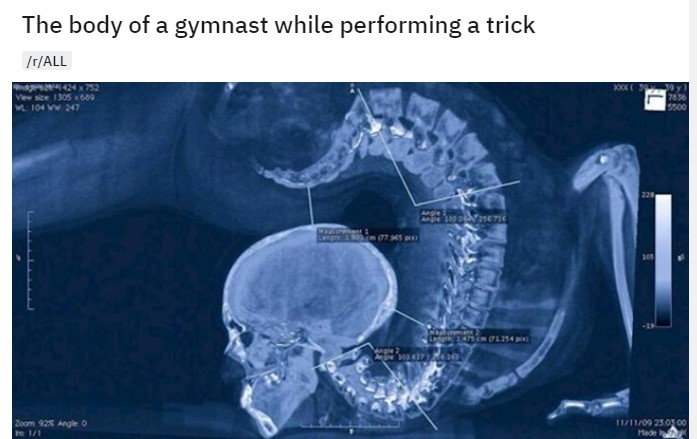
In July 2021, as the Olympic Games were underway, an image supposedly showing an X-ray of a gymnast in the middle of a stunt was widely circulated on social media:


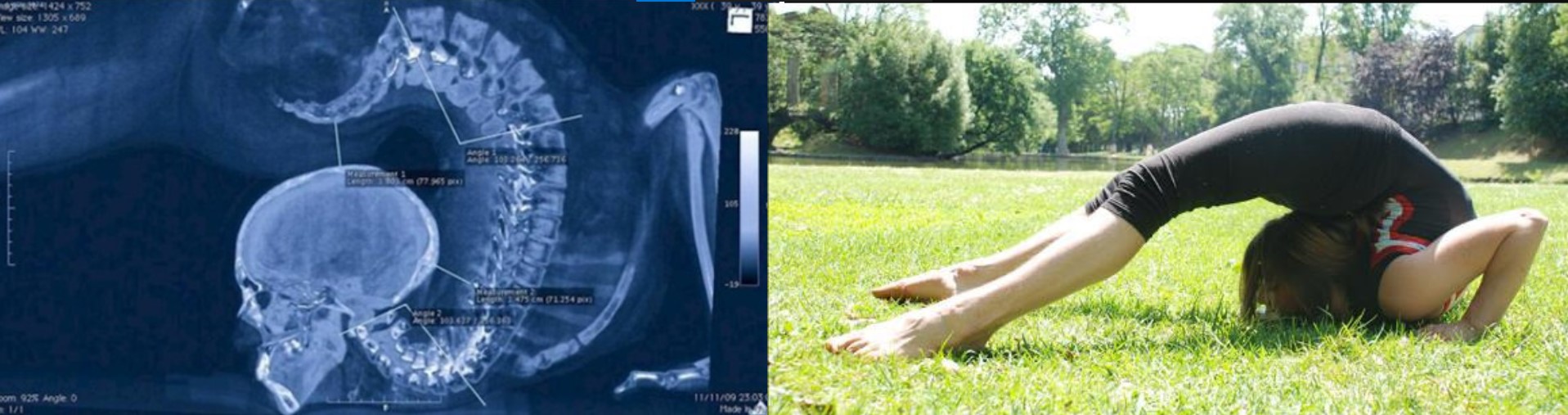
This is a genuine X-Ray (or more accurately a CT scan) of a person in a seemingly uncomfortable position. This image has nothing to do with the 2020 Olympics, however, and it does not show a gymnast in the middle of a stunt.

This image shows contortionist Irene Betti and was first popularized when it posted to the website of a Contortion Amsterdam, a stretching studio in the Netherlands. The studio writes on its website:

Contortion Amsterdam in Amsterdam is one of the few places in Europe who offers stretching on a professional level. Not only contortionists but also dancers, gymnasts and performers visit me for a professional stretch. Performers from the Cirque du Soleil and other International performers are regular visitors of my studio for maintaining and developing their flexibility.

But also amateurs do their first steps here to a possible professional carrier. Or they just train for fun because flexibility feels so good. I train amateur pole dancers, contortionists, (silk) aerialists and more. Because of my knowledge of stretching techniques and intensive personal support, my clients are always happily surprised by the fast results.

This image is no longer available on Contortion Amsterdam’s website, and we have not been able to find any archived versions. However, a slightly different version of this image has also been posted to the studio’s Facebook page:


The image has been going around for years. In 2018, it was posted to Reddit along with some now-defunct links back to Contortion Amsterdam’s websites. While those links are no longer operational, the Reddit post included the caption that supposedly accompanied this image:

One of my students in the scanner doing a ‘head to butt’ backbend. Notice that a significant part of the spine does not bend. The biggest angle in the back is where lumbar vertebra go over in the thoracic vertebra. The biggest bend is in the cervical vertebrae, the neck. The secret of a successful backbend lies in a supple neck.

Other postings of this image identified the featured contortionist as “Irene Betti.”

We reached out to Betti and she confirmed that she is the contortionist in this image. Betti couldn’t remember the specific details about the image, but said that it was taken by Michel Ritz, a French physiotherapist who studies contortionists. Betti said (translated via Google and edited for clarity):

Ciao sì sono io. È un immagine di lavoro del medico Michel Ritz, è un fisioterapia Francese che ha approfondito gli studi sul contorsionisti.


Hi yes it’s me. It is a professional image of the doctor Michel Ritz, he is a French physiotherapy who has deepened his studies on contortionists.

We found another photograph of Betti in a similar position to the pose shown in the CT scan image. 


Here’s a video of Betti performing in 2012:

This image truly shows a CT scan of a contortionist in a position that would be, for lack of a better word, awkward for most people. 

Adblock test (Why?)

Article From & Read More ( Does This X-Ray Show a Gymnast Performing a Trick? - Snopes.com )
https://ift.tt/3zPTe5f

Bounce the Mosquitoes Away with This Trick! - WFXB

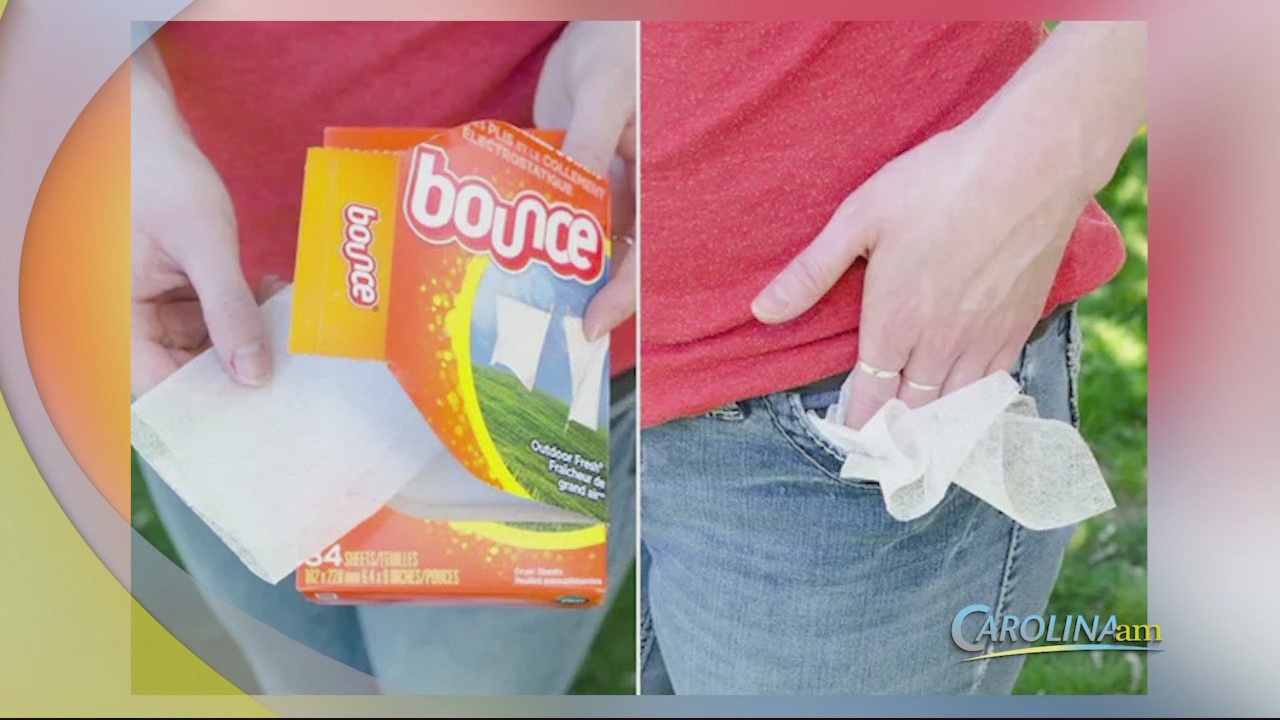
Tis the season for mosquitos. We've got a tip for that. just put a dryer sheet in your pocket.

Tis the season for mosquitos. We’ve got a tip for that. just put a dryer sheet in your pocket. Dryer sheets have been bouncing around home-related sites claiming to keep the bugs away. Bounce dryer sheets contain an ingredient linalool, which is found in plants like basil and lavender.  It  naturally repels garden pests, mites and beetles.  It can also be found in certain mosquito repellents, which may mean its worth trying next time you head outside.

Adblock test (Why?)

Article From & Read More ( Bounce the Mosquitoes Away with This Trick! - WFXB )
https://ift.tt/3rGtGER

The Ascent: 7 tips to get you started - PC Gamer

Looking for a The Ascent guide to help you survive it's dark, cyberpunk world? This isometric shooter is set in a futuristic metropolis where you are a slave to a corporation. A catastrophic event throws the entire city into chaos, and it's up to you to protect your district in this dystopian undercity.

But the neon lights aren't the only things that might overwhelm you in The Ascent. The game does a good job of pointing you in the right direction to start with, but you might find yourself struggling early on. So, here are seven The Ascent tips to help get you started.

Know when to abandon cover 

While you're equipped with a cyberdeck and various augmentations, you don't have infinite health, so you're going to fall if you soak up too many bullets. The game encourages you to use cover whenever you can, but I found this quite awkward and went for constantly evading instead. 

Cover works well for stationary objects such as turrets, but dodging feels like a far more viable tactic in most scenarios as enemies often try to surround you.

You can use the environment to your advantage, too. Exploding barrels are often dotted around contested areas, and abandoned vehicles will also explode to deal a decent amount of damage when targeted.

But prepare to die (a lot) 

Fighting thugs and ferals can be tricky, especially at the beginning when you have limited weapons. But killing enemies nets you much-needed experience points, so each time you get backed into a corner, overwhelmed by a swarm of enemies, or taken out by a particularly vicious enemy turret, you're getting stronger.

There are a few points where the difficulty seems to spike later on, especially on some boss fights. Trying out different weapon combinations can help, but mostly, it's just a matter of adjusting to the learning curve and getting used to the boss' abilities.

Check your equipment often 

This is especially important early on. You start with an adequate pistol and armour, but getting yourself a better weapon makes those first few levels that much easier. It's worth testing out the different weapons, too. You can have two equipped—as well as one type of grenade—so it makes sense to experiment.

You'll generally get weapon and armour drops from enemies, but in the heat of battle, you may not always notice when you've picked up something new. Once the fighting has died down, hit the character menu and look out for an exclamation point on the 'loadout' and 'armour' sections.

Make use of your Augmentations 

The first Augmentation you get is Hydraulic Slam, and you should equip it right away. It's really handy early on as the AoE damage can get you out of tricky situations, especially if you're still trying to get to grips with the controls.

Aug Slots works as an extra skill and uses energy as a resource. As you pick up energy refills from enemies and crates—you should use these abilities as often as you can. You have a second slot for another Augmentation, which can be bought from a Grafter—indicated by a fuse symbol on the map—or dropped by enemies.

(Image credit: Neon Giant)

Explore areas fully 

Check every corner for crates filled with Ucreds, health, or stamina top-ups. You can also find weapon skins or upgrade currency inside closed lockers or tucked away on shelves inside deserted stores, so it's well worth fully exploring an area before proceeding.

You're likely to come across enemies, too, and everything you kill helps you level up to make missions objectives or tough bosses just a little bit easier.

Pick up sidequests 

When in the populated safe zones, it's worth talking to NPCs to see if they have any side missions for you to take on. These can be useful to help you level up if you're finding a boss or an area a little tricky or if the recommended level of the next main mission is a little high.

You can upgrade your weapons too, by visiting a Gun Smith. You'll need specific components, but you'll pick up many of these as you progress through the game. Word of warning, though: It might be wise to keep some back, as different enemies are susceptible to certain damage types. Especially bosses. Once you upgrade a weapon, enemies will drop the upgraded version, so you don't need to worry about accidentally selling it.

(Image credit: Neon Giant)

Sell bounties and weapon duplicates for extra cash 

Bounties are specific, more formidable enemies you'll come across as you explore and complete missions. They'll generally have a red skull marker above their head, making them easier to spot. Kill and loot these enemies whenever you come across them, then sell the bounty to a bartender for a decent amount of Ucreds.

There isn't a massive variety of guns, and you'll find you end up with a lot of duplicates. Sell any extras at any vendor to earn some extra Ucreds.  

Adblock test (Why?)

Article From & Read More ( The Ascent: 7 tips to get you started - PC Gamer )
https://ift.tt/3f5WH7F

Anxious about the return to 'normal'? Here are five tips to help post-pandemic anxiety - connectradio.fm

(NEW YORK) — Jamie Manning says she was excited earlier this month for a day of solo shopping in small towns outside her hometown of Washington, D.C.

It was something she would do frequently before the coronavirus pandemic, but this particular Saturday marked the first time she had done something like this in over one year.

As she sat down for lunch alone at a local restaurant and waited for her food, Manning said “my mind started to wander and I began to spiral.”

Describing the thoughts that raced through her mind, Manning, 32, explained: “There are a lot of people here. It’s really loud. I feel a little woozy. I hope my food gets here soon. I probably just need to eat something. I feel like I need to get out of here. I can’t leave because I need to eat. What if I pass out? I don’t know anyone here. DC feels so far away. Why did I come here alone? I can’t catch my breath.”

The panic attack Manning experienced was not one she expected. But as she recovered and thought about it later, she realized it was due simply to trying to reenter the world after more than a year spent socially distanced and isolated from people during the pandemic.

“I kind of felt sensory overload,” Manning told Good Morning America. “It wasn’t that I was as nervous about getting sick, it was more like, ‘Wow, I haven’t been in an environment for a very long time and it’s a lot to take in."”

Manning shared her experience in a post on Instagram and received dozens of replies from people describing similar experiences.

“It used to be really normal for me, so I was surprised I had the reaction that I did, and I was surprised by the amount of messages I got,” said Manning. “Anything we can do to normalize these feelings and help people feel like they’re not alone is important.”

The struggle some people have faced as the country has reopened over the past several months is to be expected, according to Divya Robin, a New York City-based psychotherapist.

“For the last year to year-and-a-half we’ve been repeatedly told to stay home, wear a mask, social distance,” said Robin. “That’s been the message that’s completely wired in our brain. We were almost trained to be fearful of seeing people, fearful of the virus.”

“Now we have to give our brain time to adapt again, to shift again what we’re doing,” she said. “We have to think back to March, and the time it took then.”

The increased anxiety felt by many people mostly stems from the uncertainty and lack of control around the pandemic, according to Robin.

Those feelings may be even more intense now as the United States faces a COVID-19 summer surge as the delta variant spreads.

“We all have a fear system in our brains and that’s where anxiety stems from,” she explained. “We’re used to day-to-day there being a few times that it’s activated, like if you’re walking on the street and a car comes near you.”

“Over the past year of the pandemic and what’s going on now with the uncertainty around new variants coming and cases rising, it’s been activated nearly constantly,” Robin added. “That’s one of the reasons anxiety has shown up for more people.”

Anxiety can show up in different ways for different people, from overwhelming and worrisome thoughts to physical symptoms like chest tightness, fatigue, brain fog and difficulty concentrating and focusing, according to Robin.

While it’s important to know and expect that anxiety may arise, it’s just as important to have tools to handle it, she noted.

Here are five tips from Robin to help handle anxiety in a post-pandemic world.

1. Be patient with yourself:

Robin says to think of preparing yourself for a return to the office and social events in the same way you would think about getting back in shape after time away from the gym. In other words, patience.

“Two or three years ago, we’d be able to go three or four happy hours a night, and now many of us don’t have the energy,” she said. “It’s like if you go to the gym every day and run five miles and lift weights and then you don’t do it for a year-and-a-half, it’s hard to do.”

“But with time and training, it comes back,” added Robin.

2. Set small goals:

In order to train yourself to essentially be social again, Robin suggests setting small goals, like a new activity each weekend, or meeting a different friend weekly for coffee, for example.

“Don’t feel like you need to totally jump into things,” said Robin. “Start small and build your way up, just like any training program.”

Manning said she learned that lesson the hard way now looking back on her own experience.

“One of the learnings I took is I tried to do much at once,” she said. “It was easy to be like, ‘OK, great, everything is normal again,’ but I had to acknowledge that it was a lot for me to do a whole day outing and to be more intentional and ease into it.”

3. Try not to compare yourself to others:

Every person has a different perspective on and approach to post-pandemic life, so don’t compare yourself to others, recommended Robin.

“Be real with yourself about what your limits are instead of comparing yourself to other people,” she said. “Really resist the urge to compare, especially because that can cause more anxiety.”

“Instead, think about what feels right for you.”

4. Practice deep breathing:

If you feel yourself having anxiety thoughts or physical symptoms of an anxiety attack, Robin recommends practicing grounding and deep breathing techniques.

“Think about where you are in the moment,” said Robin. “If you’re sitting with a friend, feeling the sensation of your feet on the ground, your back leaning on the chair. Feeling grounded in where you are.”

“And for deep breathing, focus on really feeling your belly as you inhale. You want to feel like a balloon is being inflated inside your stomach.”

5. Pay attention to your thoughts:

Noticing the thoughts that you’re having can help you to not give into your anxious patterns, according to Robin.

“Anxiety a lot of the time stems from thinking of things that are outside our control,” she said. “Notice when those [anxious] thoughts come up and be aware of them, but don’t ruminate. Try to stay with one thought instead of ruminating and running away with all the worst case scenarios.”

Copyright © 2021, ABC Audio. All rights reserved.

Adblock test (Why?)

Article From & Read More ( Anxious about the return to 'normal'? Here are five tips to help post-pandemic anxiety - connectradio.fm )
https://ift.tt/37aElOx

Search

Entri yang Diunggulkan

A unique cellular trick may explain octopus intelligence - Scientific American

[unable to retrieve full-text content] A unique cellular trick may explain octopus intelligence    Scientific American Article From & R...

Postingan Populer