Rechercher dans ce blog

Minggu, 02 Juni 2024

What's Up: June 2024 Skywatching Tips from NASA - Science@NASA

Planets rule the a.m., and what's that bright light?

Saturn and Mars meet up with the Moon, Jupiter returns at dawn, and tips for identifying some common objects seen in the sky.

Highlights

  • All month – All the planetary action continues to be in the morning sky, with Saturn and Mars rising in the early morning hours. They are joined later in the month by Jupiter.
  • June 2 – In the hour before sunrise, reddish Mars hangs just beneath the crescent Moon. Find the pair low in the east with Saturn lurking nearby, toward the south.
  • June 3 – The crescent Moon sits beneath Mars in morning twilight. Look for them low in the eastern sky.
  • June 6 – New moon
  • June 21 – Full moon
  • June 24 – Jupiter is now visible low in the east before sunrise. Look for the bright planet around 10 degrees above the horizon this final week of June, forming a line with Mars and Saturn that stretches toward the south.
  • June 27 – Look for the Moon rising in the east with Saturn around midnight. By dawn this morning, you'll find them high in the southern sky. They appear super close together – close enough to appear in the same field of view through binoculars.

"Planet Parade" note: Some online sources have shared excitement about a "parade of planets" visible in the morning sky in early June (June 3 in particular). In reality, only two of the six planets supposedly on display (Saturn and Mars) will actually be visible. In early June, Jupiter and Mercury will be at or below the horizon in morning twilight and not visible; Uranus and Neptune are far too faint to see without a telescope, especially as the morning sky brightens. The closest thing to a planet parade will be June 29, when Saturn, the Moon, Mars, and Jupiter will line up across the morning sky. This arrangement persists into July, and we'll talk more about that lineup in the next "What's Up" video.

Transcript

What's Up for June? Saturn and Mars meet up with the Moon, Jupiter returns at dawn, and tips for identifying some common objects seen in the sky.

On June 2nd in the hour before sunrise, reddish Mars hangs beneath the crescent Moon. Find the pair low in the east with Saturn lurking nearby. The following morning, on June 3rd, the Moon has moved so that it sits beneath Mars.

During the last week of June, giant Jupiter re-emerges as a morning planet, after passing behind the Sun, from our point of view on Earth, over the past couple of months. By June 24th, you can find it about 10 degrees above the horizon as the morning sky begins to brighten. It climbs a little higher each morning after that as July approaches.

Then on June 27th, look for the Moon with Saturn. The pair rise around midnight, and by dawn you'll find them high in the southern sky. They appear super close together this morning – close enough to appear in the same field of view through binoculars.

When you spot bright or moving objects in the night sky, it might not be immediately clear what you're looking at. Is that a planet, or just a bright star? Is it a satellite, or maybe just an airplane? Here are a few quick tips on how to tell the difference.

First, there are five planets that are easily observed with the unaided eye. Of these, two planets – Venus and Jupiter – can sometimes appear incredibly bright, like shining beacons in the sky. The other planets are much less bright, but still generally shine as brightly as bright stars.

The big tipoff that you're looking at a star and not a planet is that planets tend to shine steadily, whereas stars twinkle. Stars are so far away that they're just points of light,

and ripples in our atmosphere easily distort them, causing the familiar flicker. The planets are relatively closeby, being here in our solar system. Through binoculars or a telescope, instead of a single point, planets show us a tiny disk or crescent that's illuminated by the Sun. So even though they appear star-like to the eye, the light from a planet is coming from a slightly more spread-out area, making planets appear more constant in brightness. Both planets and stars rise in the east and set in the west, and they move very slowly across the sky during the night.

But what if you see an object that's moving? Distant aircraft are usually pretty easy to identify, because they follow a slow, steady path that's straight or gently curving. They have exterior lights that flash in a regular pattern, often including a red beacon.

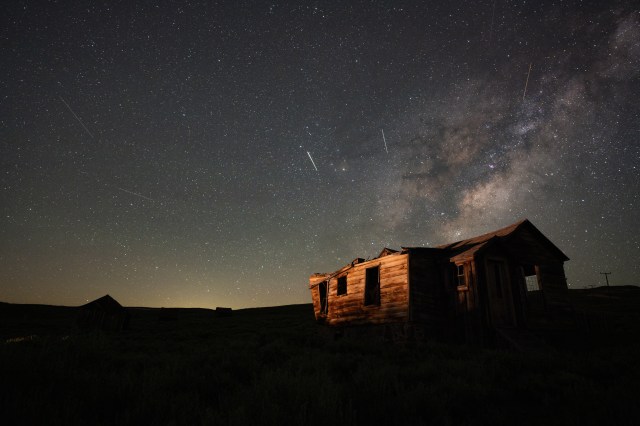
Satellites tend to be most visible in the hour or so after dark or before dawn, when it's night here on the surface, but the satellites are high enough in the sky to be illuminated by sunlight. They're generally fainter than aircraft, and move in slow, very steady, very straight paths. They might briefly flare in brightness, but they don't have lights that blink.

The International Space Station is an exception, because it's very bright, and is often visible for long enough to observe the curving path of its orbit. But it doesn't have flashing lights you can see from the ground, and it does something else satellites do:  Satellites often fade out of view as they travel into Earth's shadow, or fade into view as they emerge. And occasionally you might see a train of satellites moving slowly and silently in formation.

One other sight that's sometimes confusing is rocket launches that happen soon after sunset or before sunrise. Similar to spotting satellites, this is when it's darker here on the ground, but launching rockets climb high enough to be illuminated by sunlight. When rockets launching at these times of day get really high in altitude, their exhaust can be brilliantly illuminated, and sometimes you might even see spiral or circular shapes that slowly grow and then dissipate, as a spent rocket stage empties its propellant into space.

With so much to see in the night sky, it's helpful to be familiar with some of these common sights, so you can get on with your skywatching and investigate whatever mysteries and wonders you're in search of.

Here are the phases of the Moon for June.

Stay up to date on NASA's missions exploring the solar system and beyond at science.nasa.gov. I'm Preston Dyches from NASA's Jet Propulsion Laboratory, and that's What's Up for this month.

Adblock test (Why?)

Article From & Read More ( What's Up: June 2024 Skywatching Tips from NASA - Science@NASA )
https://ift.tt/24o7siY

GM Patents New Way To Do The 'Cool Towel Trick' For Faster Charging - InsideEVs

One of the biggest limiting factors in fast-charging just about any EV is heat. Automakers have been looking for ways to keep charging cool, from liquid cooling cables to upping the voltage architecture of cars. On the consumer side of things, some people have found a way to trick chargers into providing faster charge rates by draping a wet cloth onto the charger handle.

Rather than reinvent the wheel or try half-baked towel tricks, General Motors is looking to a tried-and-true method to help cool things down. In a new patent published just last month, spotted by Green Car Reports, GM describes using nearly four decades-old techs to improve how electric cars are charged.

The "Cool Towel Trick"

Tesla owners have found that draping a cool, wet towel over the handle of some Superchargers will increase the charge rate of their Supercharging session. This is a method of passive cooling, which is exactly what GM is trying to achieve with its new patent.

The secret sauce is in a reliable method of non-liquid cooling using a medium called phase change material (PCM).

As the name implies, the material changes phases depending on how much heat it absorbs and releases—like from solid to liquid—to cool whatever apparatus it is working with. In GM's design, this PCM is built around the charging port and shifts from a solid to a liquid as it absorbs heat.

The heat is then dissipated through a heat spreader, similar to how some electronics have been cooled for decades. This passive cooling method is known to be efficient and reliable, plus it can help reduce weight compared to more complex solutions.

So, why is this important? Like many other EV-related complaints, it comes down to one convenience factor: charge time.

When an EV's charging components become too hot, the vehicle and charger negotiate a lower charge rate to help protect components. This is why the "towel trick" works—it helps cool the components and sensors responsible for throttling the charge rate. But don't just take my word for it, here's how GM explains it in its patent:

If the charge port temperatures exceed a predetermined threshold, the on-board control module or charging station may de-rate charging. That is, charging may continue at a reduced rate or may be paused to allow the charge port temperatures to drop. If temperatures fall below the predetermined threshold, the charge rate may be increased and/or charging may be restarted. Inhibiting a charge rate due to high charge temperatures may be inconvenient for a user. Accordingly, the industry would welcome a charge port cooling system that does not depend on liquid cooling techniques.

Sure, there are other ways to cool charging components. Tesla uses liquid-cooled charging cables in V3 Superchargers to achieve this. Hyundai, Porsche, and other automakers have also switched to 800-volt battery architecture, allowing for less current while charging and thus less heat. But PCM seems to be a cheap no-brainer if the tech proves useful in the automotive space.

It's unclear if GM will use this tech in any of its new cars, especially as it begins moving to Tesla's NACS standard. Sometimes automakers patent some pretty wild things, so whether or not the tech will make it into a production car is up in the air.

Adblock test (Why?)

Article From & Read More ( GM Patents New Way To Do The 'Cool Towel Trick' For Faster Charging - InsideEVs )
https://ift.tt/pw8KteP

Sabtu, 01 Juni 2024

Exit poll: What's behind BJP's likely hat-trick sweep in Delhi? - India Today

The India Today-Axis My India opinion poll suggests that the BJP may achieve a hat-trick of clean sweep in the national capital of Delhi. This potential victory is notable as it marks the first time the saffron party is contesting against the combined forces of the Aam Aadmi Party (AAP) and the Congress.

The Congress-AAP alliance is significant given their longstanding influence on Delhi's local government, which they have dominated since 1998. Historically, the BJP has struggled to break the hold of the AAP and Congress in local elections in Delhi--a region known for its discernible electoral preferences. However, since the 2014 national elections, the BJP has maintained an unyielding grip on Delhi's Lok Sabha seats. The exit polls indicate that this trend is likely to continue, with projections suggesting that the BJP could win all seven seats.

advertisement

Even in a less favourable scenario, the exit poll projects that the BJP might lose only one seat to the AAP-Congress alliance. Such a result would be a substantial boost for the BJP, underscoring its robust national appeal and adept electioneering strategies. It would also reflect the party's ability to counter the collective strength of its primary rivals in a crucial election.

The election has proven to be a pivotal moment for the BJP, as it took a bold step by changing six out of its seven sitting MPs ahead of the polls, introducing new faces in their stead. This strategy appears to be paying off for the BJP if the projections from the India Today-Axis My India exit polls hold true on June 4.

Over the last decade, anti-incumbency has been a significant challenge for the party. By rotating out well-known leaders such as Harsh Vardhan, Meenakshi Lekhi, Ramesh Bidhuri, and Parvesh Sahib Singh Verma, the BJP sought to refresh its image and reconnect with the electorate. This decisive move suggests that the party was willing to take risks to maintain its stronghold in the political landscape.

The BJP's success can largely be attributed to its robust support base among urban middle-class voters and the 'Modi effect'. Prime Minister Narendra Modi’s appeal, particularly in urban areas, appears to have been a major factor in swaying voters in the BJP's favour.

Additionally, the BJP's strategy of working as a cohesive unit contrasted sharply with the disjointed campaign of the opposing AAP-Congress alliance. Despite forming an alliance, the AAP and Congress failed to present a unified front, leading to a fragmented and less effective campaign. This lack of coordination likely undermined their efforts, thereby giving an edge to the BJP.

Published By:

Ajmal

Published On:

Jun 1, 2024

Adblock test (Why?)

Article From & Read More ( Exit poll: What's behind BJP's likely hat-trick sweep in Delhi? - India Today )
https://ift.tt/qFvEAry

Pet Camera Catches World's Laziest Dog Playing A Trick On Dog Walker - The Dodo

Connor Yildirim has always known that his English bulldog, Eastie, was a bit lazy. But until the other day, he didn’t realize just how far Eastie would go to preserve her sedentary lifestyle.

English bulldog lying down on bed
Connor Yildirim / @connoryildirim

Yildirim was looking at footage from the Furbo brand pet camera he uses to check in on Eastie when he saw something that immediately made him double over with laughter.

In the video, Eastie is strolling around the house when she realizes her dog walker has arrived. As soon as she notices her dog walker coming through the door, she races over to her dog bed and pretends to be asleep. And when the dog walker comes over to her and tries to get the walk started, she refuses to budge.

As soon as Yildirim posted the Furbo video to TikTok, it started amassing views. People found Eastie’s lack of enthusiasm for exercise all too relatable.

“She’s just like me,” one commenter wrote.

Yildirim wasn’t surprised when he saw Eastie trying to pull off her sneaky trick.

“She likes being inside. She likes being on her bed or her couch,” Yildirim told The Dodo.

Most dogs are obsessed with spending time outside and going on walks. But most of the time, Eastie seems a lot more like a human than a dog.

Connor Yildirim / @connoryildirim

“If you're sitting down watching TV, [she’ll] come up, lay on her back and sit there like she's watching TV with you. She sleeps on her back like a human. [She’s] like a human in a dog,” Yildirim said.

Perhaps Eastie values her rest so much because she’s saving up energy for her intellectual and linguistic pursuits. Yildirim’s girlfriend speaks Portuguese to Eastie, and according to Yildirim, Eastie understands perfectly. It takes a lot of energy being bilingual, after all.

To keep up with everything Eastie's been up to, you can follow her here. 

Adblock test (Why?)

Article From & Read More ( Pet Camera Catches World's Laziest Dog Playing A Trick On Dog Walker - The Dodo )
https://ift.tt/mBvLWzY

“Everybody walks wrong” – This walking expert gives four tips to help improve your posture and age-proof your body - TechRadar

Two people walking
(Image credit: WalkActive)

When I first heard the phrase “everybody walks wrong”, I’ll admit I raised an eyebrow. For decades I’ve been getting from A to B with a decent degree of success – why make changes now?

You might feel the same, regularly racking up 10,000 steps every day on one of the devices on our best fitness trackers list. But sports scientist and WalkActive founder Joanna Hall says we should focus on how we walk, as well as the amount of ground we cover.

“Most people appreciate there are skills and techniques you can employ to get better at a tennis serve, golf drive or front crawl in swimming,” she says. “But when we come to walk, we don’t really think about it.”

Hall, who has worked alongside London South Bank University’s Sport and Exercise Science Research Center to test her walking methodology, says there are “four common walking mistakes” most people make. To counter them, try putting her actionable tips below into practice next time you’re out for a stroll. 

Four tips for correcting 'common walking mistakes'

1. Walk out of your space

A woman walking

(Image credit: Shutterstock / MJTH)

Hall wants to reform your walk from the ground up, and that means starting with your feet. 

She says people “walk into their space”, becoming overly reliant on their hip flexors (the muscles responsible for bringing your knee towards your chest) when walking, without properly engaging their glutes and hamstrings. 

“If we are too dependent on the hip flexors, it stops us using our glutes properly,” Hall explains. “Combine that with our lifestyles and the amount we sit down, and the hip flexors gets very short. 

“If an individual goes for a walk, they can often finish the walk feeling discomfort in the lower back, or they can have tracking problems in their knees. That’s because they’re stepping forward into the space [in front of them] and negating the posterior chain [the muscles that run down the back of the body, including the glutes and hamstrings].” 

Instead, she recommends “walking out of your space”. I personally found this a tricky distinction to make, so Hall gave me a way of visualizing the difference. 

Imagine there are post-it notes with messages written on them stuck to the soles of your shoes. As you walk, try to step forward out of the space you’re occupying like the picture above, leaving your back foot behind you for a fraction longer, so someone standing behind you could quickly read the post-it note. 

“What that will do is start to utilize your glutes and your hamstrings, and it will also switch off your hip flexors, which is going to safeguard your back and improve your posture,” Hall explains.

2. Focus on your feet to fix your hips

A man walking

(Image credit: Shutterstock / AlexKich)

The next stop on this walking tour is the hips. Although, again, this second tip stems from how you’re using your feet. 

“People tend to walk with a flat foot, which is called a passive foot,” says Hall. “When we step forward into our space, the foot comes down as one unit, but the foot has 26 bones in it. 

“Where we have a bone, it’s there because it’s actually a joint, and we’re meant to have movement in it. But as a consequence of walking with a flat foot, we don’t use the foot like that.”

Hall says walking with a flat foot can put more pressure on the knees, with potential knock-on effects to the way your knees track over your toes. Happily, there’s a cost-free fix you can try. 

“The way to fix it is to imagine you have pieces of velcro on the bottom of your feet and on the path you’re walking on,” explains Hall.

“When you’re showing the post-it note to the person behind you, imagine you’re peeling that back foot off the floor bit by bit, and that will stimulate movement through the joints of the whole foot. That’s great for your posture, and it’s great for your alignment.”

3. Head and shoulders

A woman walking

(Image credit: Shutterstock / Roman Samborskyi)

Do you lean forward when you walk? Maybe you’re engrossed in your phone, or you hunch and stoop forward out of habit. Either way, Hall is telling you to stop. 

“Walking with the head leaning forward puts a lot of pressure on the back and makes it very stiff,” she says. 

“The back should be able to do four movements; flexion, extension, rotation at the thoracic [mid-] spine and also lateral movement. But when we’re stiff in the shoulders because we’re jutting forward with the head, the back loses rotational movement.”

This impacts your posture, as well as affecting your breath by limiting movement of the diaphragm, Hall says. 

“When the spine is stiff, the shoulder girdle actually starts to fall forward... This means you don’t get the opening of the shoulder when you walk, and that has implications on how the diaphragm works. It should move about 10cm with every breath, but it can only move about 4cm.” 

To counter this, imagine there’s a straight line between your shoulders and ear lobes. Then, as you walk, keep your shoulders back and your head up to create as much distance between the two as you can – no slouching.

4. Arms

A woman walking at the park

(Image credit: Shutterstock / Jacek Chabraszewski)

Finally, we come to the arms. And you’ll be happy to hear this is, in my opinion, the easiest of Hall’s four tips to put into practice. 

“You just want to feel like the arms have a natural swing. You’re not trying to swing them, mechanically there should just be a smooth flow,” explains Hall.

Why should you consider using these walking tips?

If the way you walk works for you, there’s no pressing need to change it. As I found out when I walked 10,000 steps every day for a year, there are plenty of benefits to simply upping your activity levels.

But Hall argues that, when walking is something you do on a daily basis, why wouldn’t you want more bang for your buck from each stride? 

“Regardless of who you are, what age you are or how fit you are, everybody can learn to walk better,” she says. “You will look better, you will certainly feel better, and you will be investing in a long-term better body because you are safeguarding it [by building strength and fitness]. 

“It’s intelligent. Walking is a foundational thing you do, so why wouldn’t you want to do it to the best of your ability?”

In 2013, Hall’s research with the Sport and Exercise Science Research Center, showed that those following the plan for 28 days increased their walking speed by 23%. On average, there was also a 2% reduction in their weight, 3% decrease in their estimated body fat percentage and skinfold measurements at the waist dropped by 15%. 

The study also found “improved posture and skeletal alignment”, leading to “noticeable reductions in the force experienced at the knee and ankle joints”.

You might also like...

Fitness & Wearables writer

Harry is a huge fan of picking things up, putting them down again and writing about it, which uniquely qualifies him for the position of fitness and wearables writer with TechRadar. 

He’s an NCTJ-qualified journalist with a degree in English and journalism and several years’ experience covering the health and fitness beat. This has involved writing for the likes of Men’s Health, Women’s Health, Runner’s World, Fit&Well, Live Science and Coach. 

Harry is passionate about all things exercise-related, having spent more than a decade experimenting with a wide range of training styles. He's used strength training, bodybuilding, Pilates, powerlifting, gymnastics, rowing, yoga, running, calisthenics, CrossFit and more to build a fit, functional body (and have fun while doing it). 

When he’s not writing or training, he can usually be found racing his dog Archie up scenic hills in the south west of England or working to complete his NASM-certified personal trainer qualification.

Adblock test (Why?)

Article From & Read More ( “Everybody walks wrong” – This walking expert gives four tips to help improve your posture and age-proof your body - TechRadar )
https://ift.tt/y1N5dDa

NYT 'Connections' hints and answers for June 1: Tips to solve 'Connections' #356. - Mashable

Connections is the latest New York Times word game that's captured the public's attention. The game is all about finding the "common threads between words." And just like Wordle, Connections resets after midnight and each new set of words gets trickier and trickier—so we've served up some hints and tips to get you over the hurdle.

If you just want to be told today's puzzle, you can jump to the end of this article for June 1's Connections solution. But if you'd rather solve it yourself, keep reading for some clues, tips, and strategies to assist you.

What is Connections?

The NYT's latest daily word game has become a social media hit. The Times credits associate puzzle editor Wyna Liu with helping to create the new word game and bringing it to the publications' Games section. Connections can be played on both web browsers and mobile devices and require players to group four words that share something in common.

Each puzzle features 16 words and each grouping of words is split into four categories. These sets could comprise of anything from book titles, software, country names, etc. Even though multiple words will seem like they fit together, there's only one correct answer. If a player gets all four words in a set correct, those words are removed from the board. Guess wrong and it counts as a mistake—players get up to four mistakes until the game ends.

Players can also rearrange and shuffle the board to make spotting connections easier. Additionally, each group is color-coded with yellow being the easiest, followed by green, blue, and purple. Like Wordle, you can share the results with your friends on social media.

Here's a hint for today's Connections categories

Want a hit about the categories without being told the categories? Then give these a try:

Mashable Top Stories
Stay connected with the hottest stories of the day and the latest entertainment news.
Sign up for Mashable's Top Stories newsletter
By signing up you agree to our Terms of Use and Privacy Policy.
Thanks for signing up!
  • Yellow: ASAP

  • Green: Natural events of the sea

  • Blue: Back and bicep day

  • Purple: Not quite famous philosophers

Here are today's Connections categories

Need a little extra help? Today's connections fall into the following categories:

  • Yellow: "Don't Delay!"

  • Green: Ocean Phenomena

  • Blue: Dumbbell Exercises

  • Purple: Philosopher Homophones

Looking for Wordle today? Here's the answer to today's Wordle.

Ready for the answers? This is your last chance to turn back and solve today's puzzle before we reveal the solutions.

Drumroll, please!

The solution to Connections #356 is...

What is the answer to Connections today

  • "Don't Delay!": HURRY, NOW, PRONTO, STAT

  • Ocean Phenomena: CURRENT, DRIFT, TIDE, WAVE

  • Dumbbell Exercises: CURL, FLY, PRESS, ROW

  • Philosopher Homophones: LOCK, MARKS, PANE, RUSTLE

Don't feel down if you didn't manage to guess it this time. There will be new Connections for you to stretch your brain with tomorrow, and we'll be back again to guide you with more helpful hints.

Is this not the Connections game you were looking for? Here are the hints and answers to yesterday's Connections.

Topics Connections

Adblock test (Why?)

Article From & Read More ( NYT 'Connections' hints and answers for June 1: Tips to solve 'Connections' #356. - Mashable )
https://ift.tt/9JSrqsh

What's Up: June 2024 Skywatching Tips from NASA - Science@NASA

Planets rule the a.m., and what's that bright light?

Saturn and Mars meet up with the Moon, Jupiter returns at dawn, and tips for identifying some common objects seen in the sky.

Highlights

  • All month – All the planetary action continues to be in the morning sky, with Saturn and Mars rising in the early morning hours. They are joined later in the month by Jupiter.
  • June 2 – In the hour before sunrise, reddish Mars hangs just beneath the crescent Moon. Find the pair low in the east with Saturn lurking nearby, toward the south.
  • June 3 – The crescent Moon sits beneath Mars in morning twilight. Look for them low in the eastern sky.
  • June 6 – New moon
  • June 21 – Full moon
  • June 24 – Jupiter is now visible low in the east before sunrise. Look for the bright planet around 10 degrees above the horizon this final week of June, forming a line with Mars and Saturn that stretches toward the south.
  • June 27 – Look for the Moon rising in the east with Saturn around midnight. By dawn this morning, you'll find them high in the southern sky. They appear super close together – close enough to appear in the same field of view through binoculars.

"Planet Parade" note: Some online sources have shared excitement about a "parade of planets" visible in the morning sky in early June (June 3 in particular). In reality, only two of the six planets supposedly on display (Saturn and Mars) will actually be visible. In early June, Jupiter and Mercury will be at or below the horizon in morning twilight and not visible; Uranus and Neptune are far too faint to see without a telescope, especially as the morning sky brightens. The closest thing to a planet parade will be June 29, when Saturn, the Moon, Mars, and Jupiter will line up across the morning sky. This arrangement persists into July, and we'll talk more about that lineup in the next "What's Up" video.

Transcript

What's Up for June? Saturn and Mars meet up with the Moon, Jupiter returns at dawn, and tips for identifying some common objects seen in the sky.

On June 2nd in the hour before sunrise, reddish Mars hangs beneath the crescent Moon. Find the pair low in the east with Saturn lurking nearby. The following morning, on June 3rd, the Moon has moved so that it sits beneath Mars.

During the last week of June, giant Jupiter re-emerges as a morning planet, after passing behind the Sun, from our point of view on Earth, over the past couple of months. By June 24th, you can find it about 10 degrees above the horizon as the morning sky begins to brighten. It climbs a little higher each morning after that as July approaches.

Then on June 27th, look for the Moon with Saturn. The pair rise around midnight, and by dawn you'll find them high in the southern sky. They appear super close together this morning – close enough to appear in the same field of view through binoculars.

When you spot bright or moving objects in the night sky, it might not be immediately clear what you're looking at. Is that a planet, or just a bright star? Is it a satellite, or maybe just an airplane? Here are a few quick tips on how to tell the difference.

First, there are five planets that are easily observed with the unaided eye. Of these, two planets – Venus and Jupiter – can sometimes appear incredibly bright, like shining beacons in the sky. The other planets are much less bright, but still generally shine as brightly as bright stars.

The big tipoff that you're looking at a star and not a planet is that planets tend to shine steadily, whereas stars twinkle. Stars are so far away that they're just points of light,

and ripples in our atmosphere easily distort them, causing the familiar flicker. The planets are relatively closeby, being here in our solar system. Through binoculars or a telescope, instead of a single point, planets show us a tiny disk or crescent that's illuminated by the Sun. So even though they appear star-like to the eye, the light from a planet is coming from a slightly more spread-out area, making planets appear more constant in brightness. Both planets and stars rise in the east and set in the west, and they move very slowly across the sky during the night.

But what if you see an object that's moving? Distant aircraft are usually pretty easy to identify, because they follow a slow, steady path that's straight or gently curving. They have exterior lights that flash in a regular pattern, often including a red beacon.

Satellites tend to be most visible in the hour or so after dark or before dawn, when it's night here on the surface, but the satellites are high enough in the sky to be illuminated by sunlight. They're generally fainter than aircraft, and move in slow, very steady, very straight paths. They might briefly flare in brightness, but they don't have lights that blink.

The International Space Station is an exception, because it's very bright, and is often visible for long enough to observe the curving path of its orbit. But it doesn't have flashing lights you can see from the ground, and it does something else satellites do:  Satellites often fade out of view as they travel into Earth's shadow, or fade into view as they emerge. And occasionally you might see a train of satellites moving slowly and silently in formation.

One other sight that's sometimes confusing is rocket launches that happen soon after sunset or before sunrise. Similar to spotting satellites, this is when it's darker here on the ground, but launching rockets climb high enough to be illuminated by sunlight. When rockets launching at these times of day get really high in altitude, their exhaust can be brilliantly illuminated, and sometimes you might even see spiral or circular shapes that slowly grow and then dissipate, as a spent rocket stage empties its propellant into space.

With so much to see in the night sky, it's helpful to be familiar with some of these common sights, so you can get on with your skywatching and investigate whatever mysteries and wonders you're in search of.

Here are the phases of the Moon for June.

Stay up to date on NASA's missions exploring the solar system and beyond at science.nasa.gov. I'm Preston Dyches from NASA's Jet Propulsion Laboratory, and that's What's Up for this month.

Adblock test (Why?)

Article From & Read More ( What's Up: June 2024 Skywatching Tips from NASA - Science@NASA )
https://ift.tt/rz1MUmO

Search

Entri yang Diunggulkan

A unique cellular trick may explain octopus intelligence - Scientific American

[unable to retrieve full-text content] A unique cellular trick may explain octopus intelligence    Scientific American Article From & R...

Postingan Populer